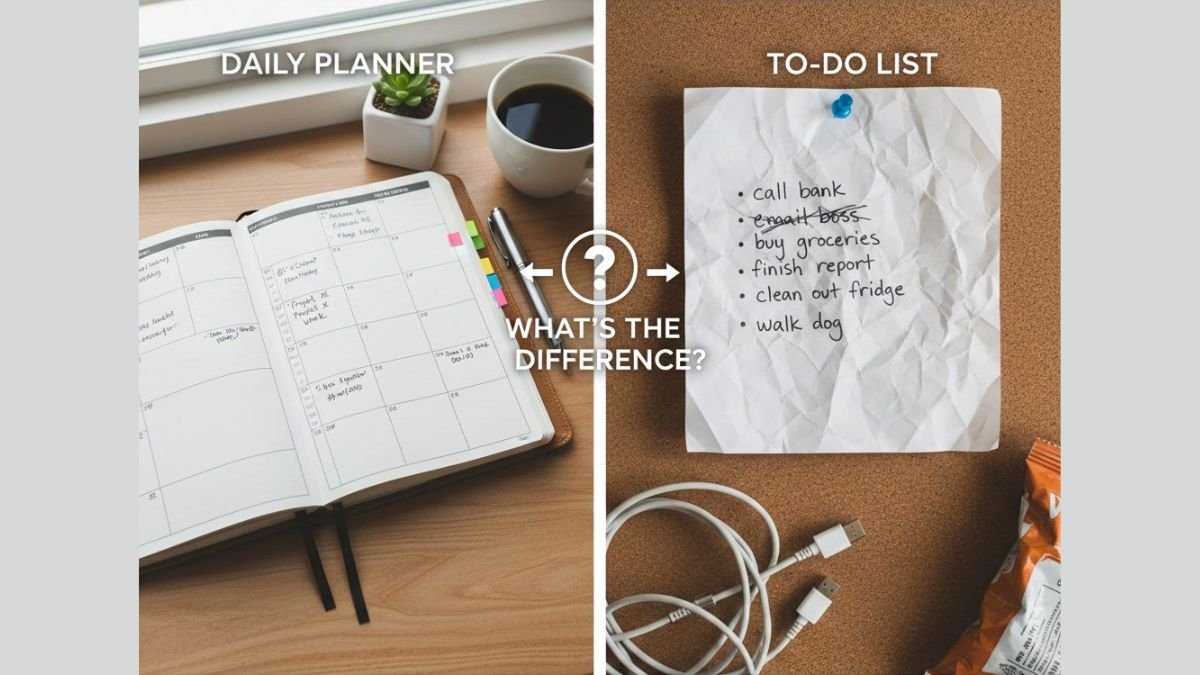
Daily Planner vs. To-Do List: What’s the Difference and Why It Matters
In 2025, most people still use a to-do list and wonder why they end the day exhausted but with nothing important finished.
The ones who actually get things done? They ditched the endless list and switched to a daily planner.
Here’s the brutal truth about why these two tools are completely different animals — and why the difference decides whether you control your day or your day controls you.
| Feature | To-Do List | Daily Planner |
|---|---|---|
| Core Philosophy | “Here are all the things I should do” | “Here is exactly what I WILL do today” |
| Primary Question | What needs doing? | WHEN will I do it? |
| Typical Length | 10–50 items (grows all day) | 3–10 items max (realistic) |
| Time Awareness | None | Built-in (time-blocking) |
| Feeling at End of Day | “I only did 4 of 27 things → failure” | “I did my 3 big things → win” |
| Stress Level | High (infinite scrolling guilt) | Low (clear finish line) |
Why To-Do Lists Secretly Sabotage You
- They Lie to You
A list of 25 tasks feels productive to write, but it’s a fantasy. You’ll do maybe 5. The other 20 become guilt. - No Context
“Answer emails” can eat 3 minutes or 3 hours. Without a time budget, it always eats 3 hours. - Everything Feels Equally Urgent
Buy milk and finish $10k proposal sit next to each other → brain melts. - Endless Carry-Over
Same 7 tasks get rewritten every day for two weeks → soul-crushing.
Why Daily Planners Actually Work
- They Force Hard Choices
You can only fit ~10 realistic tasks with time blocks. Everything else goes to “Later” or gets delegated/deleted. - They Respect Reality
A planner shows you only have 4 focused hours a day — so you protect them like gold. - They Create a Finish Line
When your last block ends at 5:30 PM and your 3 big things are done → day is officially won. Guilt-free Netflix. - They Compound
3 meaningful things finished daily = 1,000+ in a year. That’s how books get written, bodies get transformed, businesses get built.
The 60-Second Switch Exercise (Do This Tonight)
- Open your current to-do list
- Pick ONLY 3 things that would make tomorrow a win
- Open your daily planner (Daily Planner or paper)
- Give each of those 3 things an actual time block tomorrow
- Delete or move everything else to a “Someday” list
That’s it. You just upgraded from reactive hamster to intentional human.
Real-World Example: Same Person, Two Systems
| Morning of Jan 15 | To-Do List Version | Daily Planner Version |
|---|---|---|
| Wake up | Open list → 23 tasks → panic | Open planner → 3 blocked wins → calm focus |
| 9:00 AM | “Answer emails” (still on list) | 9:00–9:30 → Email batch (done ✓) |
| 11:00 AM | Random Slack fires → context-switch | Deep work block protected → proposal 80 % done |
| 6:00 PM | 7 of 23 tasks done → feel like failure | 3 wins + 4 small tasks done → day crushed |
| Mood | Exhausted + guilty | Energized + proud |
Bottom Line
A to-do list is a wish list.
A daily planner is a commitment contract with yourself.
One keeps you busy.
The other makes you successful.
If you’re still using a to-do list in 2025, you’re voluntarily carrying a backpack full of guilt everywhere you go.
Drop the list.
Pick up a planner.
Watch your life change in a week.
Want the exact daily planner template that replaces to-do lists forever (with built-in 1-3-5 rule, time-blocks, and “done” celebration section)? → Daily Planner
Stop wishing.
Start scheduling.
Hi, I’m Sam Thomas. I love writing about productivity and simple ways to stay organized in daily life. Through this blog, I share practical tips, planners, and ideas that have helped me stay on track. My goal is to make planning easy and useful for everyone.